
USDA Studies the Effectiveness of Spraying with a Drone
Farmers everywhere are using drones to spray their fields, but how do we determine the effectiveness of spraying with a drone? The USDA partnered with a leading agriculture university to address this exact topic: drone spraying efficacy!
Let's start with the definition of efficacy stated as: capacity for producing a desired result or effect. Easy, right? But there is more to it when it comes to drone spraying. First, we need to establish what is the desired effect? What do we compare drone spraying to when we're conducting research? Are we comparing them to other drones that spray - or are we comparing them to manned crop duster planes? How about ground tractor sprayers or backpack sprayers? All of these are popular traditional spraying methods, but in this case - the researchers decided for us! Backpack Sprayers versus Drone Sprayers
Countless organic farms use backpack sprayers today, along with ornamental growers, nurseries, melon farmers, and more. But who wants to go tromping through a field with who-knows-what crawling at your feet, decked out head-to-toe in protective gear all while blistering in the hot sun. Not to mention - that takes forever! If that isn't enough, the potential for inconsistent application and damage to the crop below... No thanks! We already know all of that... the study isn't about who wants to work harder, or who wants to dread their job, the study is about the effectiveness of spraying with a drone. This requires a scientific approach reserved for the folks who know it the best - the Agriculture Research Services (ARS) with the USDA.
Setting up the study
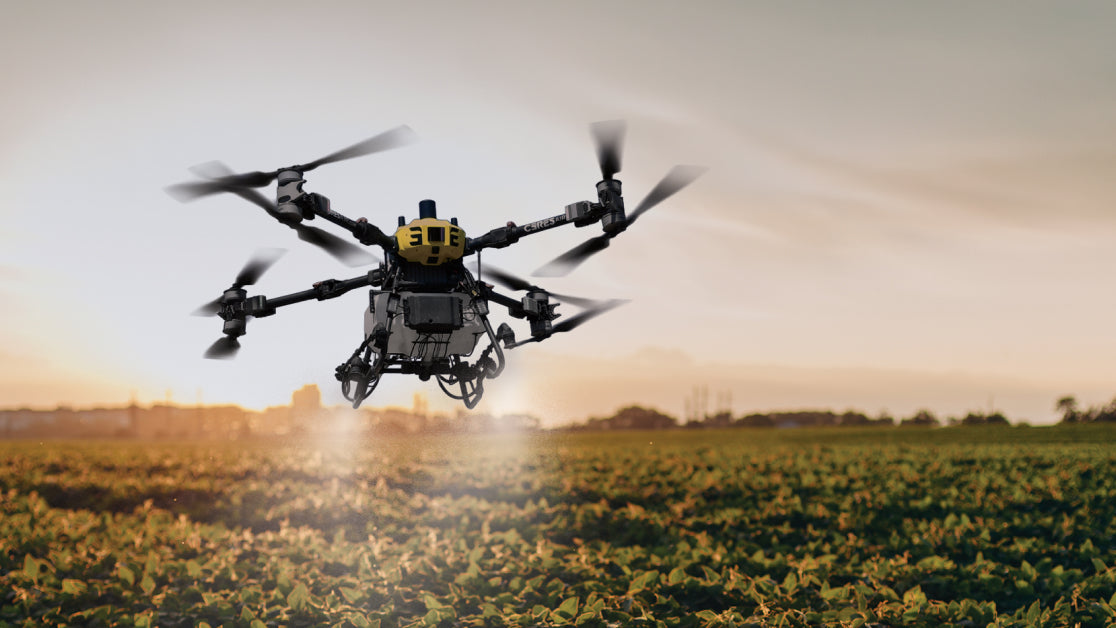
In this study, determining the efficacy or effectiveness of spraying crops with a drone involved many people. First, we have the researchers and scientists who designed the study, picked the materials, field and aircraft (OK, we're stoked - they used our M6E Spraying Drone!) But as I mentioned above, they also picked the old method to compare against - backpack spraying. This study involves placing water-sensitive test papers in the field along with a pre-treatment crop analysis conducted by the researchers. This gives them a realistic 'snapshot' of the crop before any treatment; the same testing method is setup again a few rows away. I'm going to get a bit technical here, as we always do with research...
The study uses a contact herbicide for post emergent control of weeds in major agronomic crops. What the heck does that mean? Basically, the weeds are everywhere, get enough of the herbicide on them and kill them before they take over our money-making crop (a.k.a. agronomic crop). The term post emergent means that the weed has already emerged and grown, which is distinct from pre-emergent control which is eradicating weeds as they germinate or sprout.
Now that the study is set, it's time to get to work!
Conducting the study
With the researchers and university students standing by in the sweltering Texas sun, they spray the first area by traditional "manual" backpack method. That is, a person carries a backpack and a hand-wand spraying the weeds. Sloshing through the soybean field, the Morning Glories and other weeds catch his feet and make the job a bit of a bear... he's not having fun, but he perseveres! Next, the M6E Spraying Drone sprays the intended area and returns to base. Next, the water-sensitive cards are collected, marked and analyzed by a fancy process developed by USDA ARS. These water sensitive cards tell them a lot... how consistent was the pattern or coverage? Were there areas missed by either method? Did the turbulence of the drone spray evenly? What did we learn about the effectiveness of spraying with the drone? Keep reading to find out!
What are the results?

The study is still underway and we'll share those results as soon as we have them...but the preliminary data shows the following!
METHOD |
BACKPACK SPRAYER |
M6E SPRAYING DRONE |
| WORKING SPEED | 3 MPH (approx) | 4.4 MPH (approx) |
| SPRAY SWATH | 6.6 FT (approx) | 10 FT (approx) |
| WATER USED | 15 GAL | 4 gal |
- The drone achieved the same or better effectiveness as the backpack sprayer method (final details to come)
- By using the right nozzle type, the spray drone was able to comply with the chemical label and achieved proper droplet spectra
- Unwanted drift was managed successfully by selecting the proper nozzle type
What's Next?
Second, ditch that backpack sprayers and step into the future!
Contact us to learn more about our spraying drones for sale!


 "
"


