
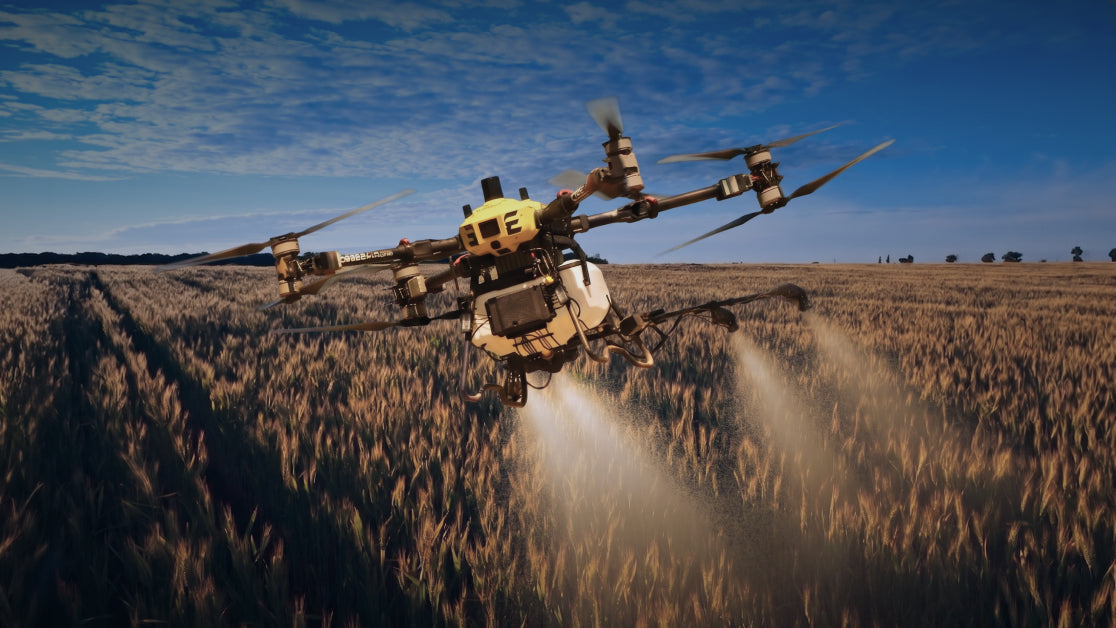
The Power of the Pack: Mastering Battery Life and Charging Logistics
In high-acre drone logistics operations, productivity is determined by the pacing of the logistics chain. While many focus on tank size or the wind, the real governor of daily throughput is usually the batteries. In the agricultural drone world, Agricultural drone batteries aren't just fuel tanks; they are high-value, consumable assets that require mechanical discipline to maintain.
In the field, an operator either "burns and turns" packs—resulting in a shortened lifespan [7]—or follows a disciplined rotation that yields thousands of cycles of peak performance [21]. For a 1,000+ acre operation, mastering the use of hot swap batteries is a requirement for keeping the cost-per-acre sustainable.
The "Rule of Three" Rotation
To maintain 100% up-time with a heavy-lift platform like the Vector HD580 or Ceres Air Black Betty, the cycle must respect the chemistry. A minimum of three sets of batteries per aircraft is the highly recommended baseline to ensure the "iron" never sits idle.
A "set" refers to the total number of batteries required for a single flight. This requirement varies by airframe:
-
The Vector HD580: Uses one battery per flight (1 battery = 1 set).
-
The Ceres Air Black Betty: Uses two batteries per flight (2 batteries = 1 set).
As the industry scales toward multi-battery configurations, the logistics remain the same. To maintain a proper battery rotation here is how the "Rule of Three" plays out in practical application:
-
The Flyer: The battery currently in use.
-
The Charger: The set on the tray, drawing current from the generator.
-
The Rester (Thermal Equilibrium Phase): While modern smart batteries and high-end chargers feature integrated cooling systems designed to manage heat during the charge cycle, allowing a set to "rest" remains a best practice for long-term health. Giving the cells time to move toward thermal equilibrium before or after a high-amp charge cycle helps stabilize internal resistance and ensures the pack reaches its maximum lifespan [21].
While three sets are the baseline for maintaining continuous operations, moving to a 4- or 5-set rotation further extends this "thermal buffer." More sets mean longer rest periods, allowing the batteries to shed internal heat more effectively. In high-heat summer conditions or for operators pushing 1,000+ acre days, these additional sets are an insurance policy on the long-term health of the battery fleet [21].
Establishing the Scaling Hierarchy: Batteries vs. Chargers
When looking to scale, capital should be deployed strategically. While both batteries and drone charging solutions add capacity, they solve different bottlenecks.
The Case for Extra Batteries (Prioritizing Chemistry)
-
Pros: This is the only way to satisfy the "Rule of Three" and allow for optimized cooling periods. It also provides a buffer; if one pack shows a cell imbalance, spares are available to keep the crew moving.
-
Cons: Higher upfront cost and more assets to track and store.
The Case for Extra Chargers (Prioritizing Redundant Logic)
-
Pros: Multiple chargers allow for parallel charging, essential for multi-aircraft teams. It also eliminates a single point of failure; if a charger’s internal cooling fails, a second unit keeps the operation moving.
-
Cons: Multiple ultra-fast chargers pull massive loads. Newer chargers are heading in the direction of 15kW+ requirements, which can quickly overwhelm smaller mobile power units [24].
The Verdict: Establishing a minimum 3-set battery rotation is the highly recommended baseline. Once this is reached, expansion should be based on the specific bottleneck: if the goal is electrical redundancy for multi-drone teams, add a second charger. If the goal is maximizing pack longevity in high-heat environments, invest in a 4th or 5th set of Agricultural drone batteries.
Protecting the "20% Floor"
Protecting the ROI of an operation requires avoiding the "run it till it dies" approach. Pushing a battery below 20% capacity creates a high risk of permanent cell damage [21]. To mitigate this, both the Vector HD580 and the Ceres Air Black Betty utilize built-in software within their Ground Control Stations (GCS) specifically designed to optimize this 20% floor. By programming a conservative return-to-home (RTH) trigger at 30%, the software ensures the aircraft is back on the deck with a "safety floor" of roughly 20–25% remaining capacity.
This 20% floor does more than protect the cells; it protects the charger. When a lithium battery is deeply discharged, its internal resistance increases, forcing the charger to work harder and generate more heat [23]. By landing with a 20% buffer, the charger stays in its peak efficiency window. This results in a faster "charge-to-ready" time and significantly reduces the thermal strain on the charger’s hardware.
Automated Vigilance: Brand-Specific Monitoring
Modern ag-drones utilize specialized software to take the guesswork out of battery health.
-
Vector HD580: Smart BMS Telemetry: The Vector utilizes a proprietary Battery Management System (BMS) that tracks individual cell resistance and total cycle counts for every pack in the fleet [18]. During operation, the GCS provides "Real-Time Health Scores." If a specific cell begins to "sag" (drop voltage faster than others) during a maneuver, the system alerts the pilot immediately.
-
Ceres Air Black Betty: Dual-Pack Synchronization: Because the Black Betty runs a "stacked" configuration, its software monitors the balance between the two separate physical packs [19]. The system ensures that current is drawn equally. If it detects a 5% or greater variance in discharge rate between the two packs, it provides a diagnostic warning to prevent one pack from "dragging down" the other.
Daily Care and Operational Readiness
Beyond chemistry, the physical health of the battery determines flight safety. Arcing, corrosion, or physical deformation are early warning signs of failure.
The Daily "Ready-to-Fly" Checklist:
-
[ ] Visual Case Inspection: Check for any "puffing" or swelling. If the case is tight or deformed, pull it from rotation immediately.
-
[ ] Connector Health: Inspect gold-plated pins for carbon buildup (black soot) or pitting. Clean pins with 90% isopropyl alcohol if needed.
-
[ ] Voltage Delta Check: Using the GCS, verify the "Cell Delta"—the difference between the highest and lowest cell voltage. A delta higher than 0.05V indicates an imbalance requiring a slow "balance charge" [21].
-
[ ] Thermal Management: Never store batteries in direct sunlight. Use a shaded, ventilated area or a temperature-controlled trailer.
Powering the Trailer: The Move to Diesel
The generator is the heart of the rig, and sizing it for the future is critical to avoid forced obsolescence. As the industry moves toward larger airframes and swarming, the power requirements are shifting from portable units to 40kW–50kW Diesel Generators.
-
High-Output Capacity: With next-generation chargers pulling 15kW+ each, smaller generators cannot keep pace with a dual-charging setup. A 40kW+ Diesel unit provides the "headroom" to run multiple ultra-fast chargers at 100% capacity while simultaneously powering trailer logistics.
-
Fuel Efficiency & Growth: As airframes continue to scale toward multi-battery configurations, power requirements will only increase. Industrial Diesel units are built for continuous 100% duty cycles and offer better long-term fuel economy compared to gas equivalents [20].
-
Altitude & Surge Handling: Diesel units provide the necessary torque to handle the sudden "surge" when a charger kicks in, ensuring steady, "clean" power that protects sensitive electronics regardless of air density or elevation.
Storage and Off-Season Care
Lithium batteries are "living" chemistry; they hate sitting at 100% charge and they hate being empty.
-
The "Storage Charge": If the rig is sitting for more than 48 hours, batteries should be discharged or charged to a storage voltage of roughly 3.85V per cell (50–60% SoC) [21].
-
Climate Control: Extreme cold leads to cell imbalance [23], while extreme heat leads to "thermal runaway" risks. Keeping assets in a temperature-controlled environment ensures they are ready for the next season.
The Raptor Bottom Line
Batteries are an investment, not a nuisance. By treating battery management with the same respect given to a tractor engine, an operator ensures that cost-per-acre stays low and up-time stays high.
The mission is simple: Protect the asset, maximize the window, and keep the rotors turning.


 "
"


