
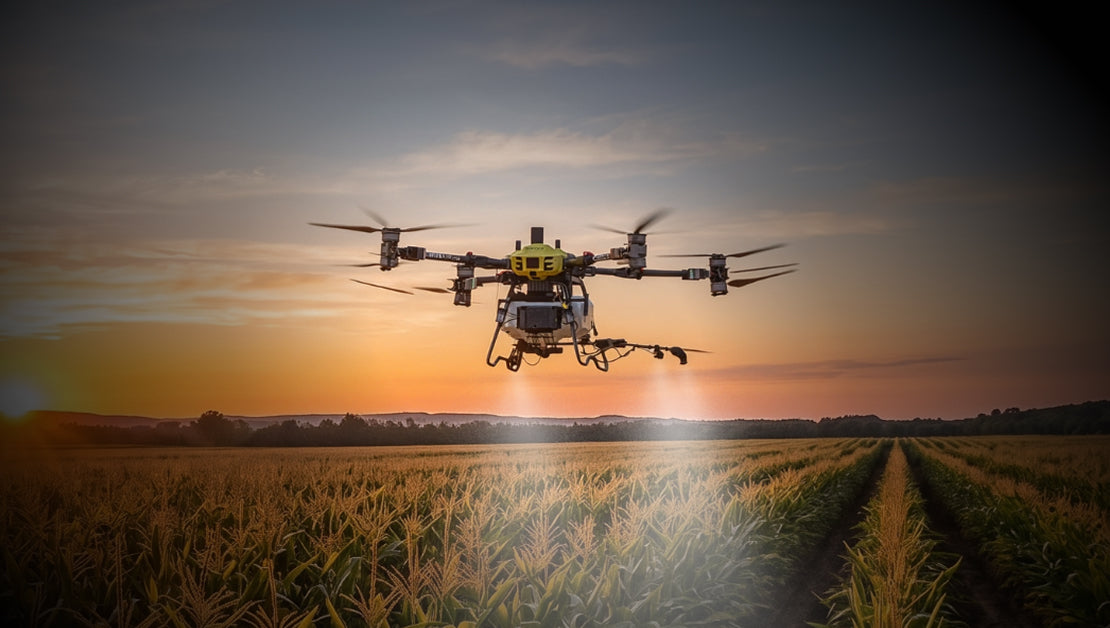
Night Spray Drone Operations: Maximizing Efficacy and Extending the Spray Window
In the heat of pray season, time is one thing you can’t buy more of. By 2026, the industry has shifted; the most successful operators are no longer parking the iron when the sun sets. They are moving into the night spray window where the wind dies down, the air stabilizes, and the chemistry actually has a chance to perform as intended.
Running a nighttime crop spraying operation isn't about chasing a trend; it’s about putting your equipment to work when the conditions are best for the crop and your bottom line. Since spray windows are narrow and often dictated by weather, mastering the night is how you reclaim those lost hours and ensure your spray application has the absolute best environment to perform.
Why the Night Window is a Strategic Advantage
Most growers are used to fighting 15 mph winds and the midday "evaporation tax." Moving to nighttime crop spraying changes the math on chemical performance.
-
Stable Air and Spray drift reduction: At night, the air is typically more "laminar" (smooth). Without the sun heating the ground, you avoid the turbulent updrafts that carry droplets off-target. Research shows that nighttime applications can reduce spray drift by up to 86% in many environments.¹³
-
The "Hygroscopic" Advantage: Agricultural drone applications rely on low-volume carriers (typically 2 GPA). At midday, those droplets can evaporate in seconds, often crystallizing before they ever enter the plant. Higher humidity at night (typically above 70% RH) extends the "delta-T" window, keeping the droplet in a liquid state on the leaf up to 3x longer than midday applications. This extended hydration period can increase the absorption of systemic active ingredients by 15–20%, as the plant's stomata remain receptive without the stress of high-noon transpiration.¹⁶
Sensor Redundancy and Safety at 2:00 AM
Safely operating a heavy-lift agricultural drones in total darkness is a matter of technical redundancy, not human eyesight. Modern agricultural spray drones like the Vector HD580 and Ceres Air Black Betty utilize sensor suites specifically designed to turn low-light environments into an operational advantage.
-
Phased-Array Radar (Vector HD580 & Ceres Air Black Betty): Unlike cameras that rely on light, radar uses radio waves to "see" through darkness, dust, and mist. These sensors provide 360-degree obstacle detection and can spot a utility wire or standpipe from 50 feet away in total blackness.¹⁸ Both platforms use this to maintain an active safety perimeter.
-
Binocular Vision & LiDAR (Vector HD580 & Ceres Air Black Betty): The Vector HD580 uses dual-camera "stereo vision" to perceive depth and detect obstacles,¹⁸ while the Ceres Air Black Betty utilizes advanced LiDAR to build a 3D point-cloud map of the terrain.¹⁹ This allows for precise Terrain Following, maintaining a consistent 10-foot altitude over the crop regardless of hills or dips that are hard to judge visually at night.
-
Low-Light FPV & LED Strobes: High-intensity LED lighting isn't just for the ground—it’s for the pilot. Modern First-Person View (FPV) cameras are optimized for low-light, often making obstacles like power lines easier to spot against the night sky than during the high-glare "golden hour" of sunset.
Drone vs. Manned Aircraft: A Complementary Approach
Agricultural aviation is a cornerstone of this industry, but manned platforms face significant safety constraints after dark. For any pilot, the risk of low-altitude flight at high speeds increases dramatically once the sun goes down. Agricultural dDrones serve as a complementary tool here, augmenting existing aerial fleets by specializing in those low-light hours.
Because agricultural drones
rely on automated sensor suites, they can safely fill the "midnight window" that is often inaccessible to manned aircraft—provided the equipment is used correctly and the field has been properly mapped. This allows the grower to keep the operation moving around the clock without the safety risks associated with manned nighttime flight.
Thermal Inversions: The Proactive Operator's Guide
While night air is stable, an educated operator knows that "dead calm" is not the same as "ideal." We advise growers to watch for temperature inversions—conditions where warm air traps a layer of cooler, denser air near the ground. In these conditions, droplets can stay suspended and move laterally if not managed.
The advantage of an agricultural drone is having the tools to mitigate these effects:
-
Vertical Downwash: Unlike a fixed-wing aircraft that glides over the field, a multi-rotor drone creates a vertical column of air. This downwash physically interrupts the suspension layer of an inversion, forcing droplets down into the canopy.
-
Precision Boundary Management: By utilizing high-resolution maps, you can program "buffer zones" around sensitive borders. If the wind is below 2 mph, you can adjust your path to ensure the product stays within the fence line.
-
Real-Time Telemetry: Modern Ground Control Stations (GCS) pull real-time weather data. We look for a 3–10 mph "sweet spot" to ensure there is enough air movement to prevent an inversion from trapping product, while the drone’s downwash drives it deep into the canopy.¹⁷
Navigating the Regulatory Landscape
Effective drone spraying at night requires more than just a set of lights. To stay compliant and safe, operators must follow FAA requirements and industry best practices:
-
FAA Part 107.29 Compliance: You must have completed the training or testing that includes night-operating protocols.
-
The Mandatory Daylight Survey: You cannot safely map or fly a field at night that you haven't seen in the daylight. Best practice is a physical site survey during the day to identify "hidden" hazards like guy-wires or new standpipes that might not be on your digital map.
-
Anti-Collision Lighting: The aircraft must have anti-collision lights visible for 3 statute miles, and the pilot must be able to distinguish orientation using navigation lights.
-
Preserving Night Vision: White light is the enemy of a night crew. It is recommended using red-filtered lights for your Ground Control Station (GCS) and trailer. This allows you to check monitors an
Conclusion: Managing the Window
The goal of any application is the best possible result for the crop. The night spray window offers a level of precision and spray efficacy that daytime applications often can’t match due to wind and heat. Whether it’s helping you understand local weather conditions or ensuring your sensors are calibrated for the midnight shift, our 60+ service centers are staffed with people who understand that the job doesn't always end at 5:00 PM.
The night spray window is open for operators ready to take advantage of it. We’re here to help you get the setup right.


 "
"


